

📖 Today’s Edition
The Big Story: The market is shifting from AI that just writes content (Generative AI) to AI that takes action (Agentic AI).
Trends: Open-source models are making it cheaper and easier for businesses to build their own specialized AI agents.
The Workflow: A step-by-step guide to automating your competitor analysis using no-code AI tools.
🚀 AI News & Breakthroughs
THE SHIFT TO ‘AGENTIC AI’: YOUR NEW DIGITAL EMPLOYEE
Enterprises are moving beyond using AI for content creation and are now embracing “agentic AI” — autonomous systems that can perform tasks and manage workflows.
The Details:
Unlike Generative AI (like ChatGPT) which responds to one-off prompts, Agentic AI can reason, plan, and execute multi-step tasks to achieve a goal.
Think of it as giving an AI a project, not just a question. Examples include managing inventory, processing insurance claims, or executing marketing campaigns.
Why it matters (Strategic Analysis):
This is the most important strategic shift in AI since ChatGPT launched. It marks the transition from using AI as a simple tool to using it as a digital employee. For founders and SMBs, this means the opportunity to automate complex business functions that previously required human oversight is rapidly becoming a reality. The competitive advantage will go to those who can identify and delegate tasks to these new AI agents first, drastically cutting operational costs.
NVIDIA MAKES BUILDING AI AGENTS EASIER FOR EVERYONE
NVIDIA has released Nemotron 3, a family of open models specifically designed to help developers build the kind of “agentic AI” systems mentioned above.
The Details:
These are “open models,” meaning they are more accessible and customizable than proprietary models from giants like OpenAI.
They are optimized to understand and execute complex instructions, which is the core of how AI agents function.
Why it matters (Strategic Analysis):
This move commoditizes the building blocks of AI agents. Before, creating a custom AI agent was complex and expensive. Now, more developers and companies can create specialized agents, leading to a Cambrian explosion of new AI-powered services. This will lower the cost for you to hire a firm to build a custom AI agent for your business or see new off-the-shelf agentic tools hit the market faster.
🛠️ AI Tools to Discover

1. DeepSeek
Build your own AI agents.
Use Case: For when you need an AI to do more than just write. Use it to build agents that can browse the web, use other software, and perform complex automation.
Pricing: Pay-as-you-go
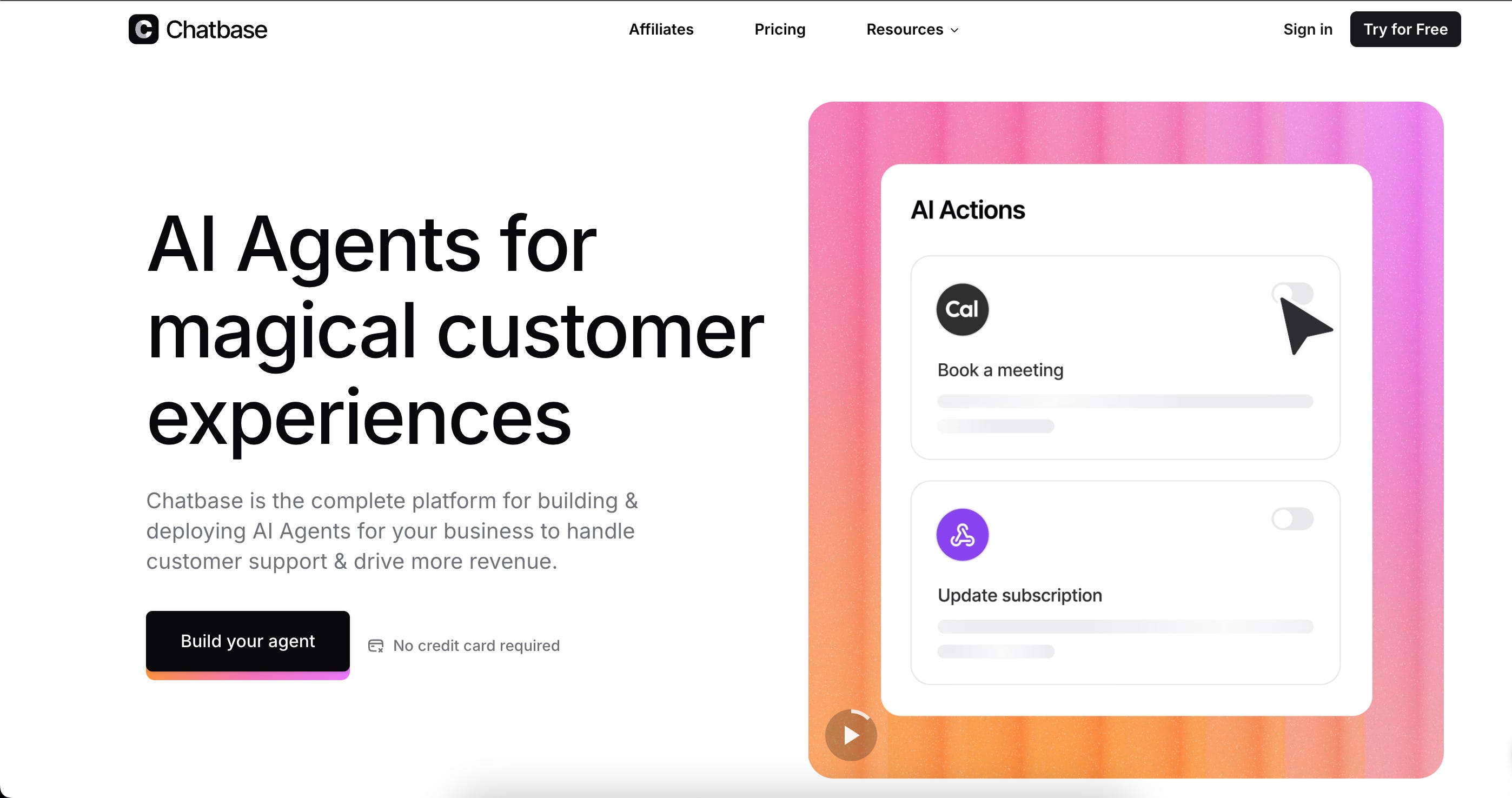
2. Chatbase
Create a custom GPT chatbot.
Use Case: Instantly create an AI chatbot for your website trained on your own documents and data. Perfect for customer support or lead generation.
Pricing: Starts Free, Paid plans available.
💡 AI Prompts & Hacks
1. The “Autonomous Agent” Delegator
Context: Use this to delegate a research task to an AI agent like those powered by DeepSeek or new GPT models.
“Act as an autonomous market research agent. Your goal is to compile a report on the top 5 competitors for a [Describe Your Business, e.g., ‘direct-to-consumer coffee brand’].
Your instructions are:
1. Independently browse the web to identify the key players.
2. For each competitor, find their pricing model, main value proposition, and target audience.
3. Summarize your findings for each.
Output Format: A markdown report with a section for each competitor, containing the requested information.”
2. The “Process Automation” Identifier
Context: Use this with your team to brainstorm what parts of your business can be automated by AI agents.
“Act as a Senior Operations Consultant. Our company is [Describe Your Company]. We want to identify the top 3 processes for automation using AI agents.
Analyze the following daily tasks performed by our team: [List 5-10 repetitive tasks, e.g., ‘Manually updating the CRM’, ‘Responding to basic customer emails’, ‘Tracking shipping status’].
Your goal is to:
1. Rank these tasks based on their potential for time-saving and ROI through automation.
2. Provide a brief justification for your top 3 choices.
3. Suggest the type of AI agent that could handle each task (e.g., ‘CRM management agent’, ‘Customer service agent’).
Output Format: A simple numbered list of your recommendations.”
3. The “Cost-Benefit Analysis” Prompt
Context: Use this to make a business case for investing in a new AI automation tool or agent.
“Act as a Chief Financial Officer. I am considering implementing an AI agent to automate [Insert Business Process, e.g., ‘inbound lead qualification’].
The AI tool costs [Insert Price, e.g., ‘$200/month’]. The task currently takes an employee [Insert Time, e.g., ‘10 hours per week’], and their hourly rate is [Insert Rate, e.g., ‘$40/hour’].
Your goal is to write a concise cost-benefit analysis. Calculate:
1. The current monthly cost of the manual process.
2. The potential monthly savings.
3. The annual Return on Investment (ROI).
4. List three non-financial benefits (e.g., ‘Reduced human error’).
Output Format: A brief, professional analysis ready for a management meeting.”
🧑🏫 AI Training: Workflow of the Day
How to Automate Your Competitor Analysis
The Goal: Save 3+ hours per week by having an AI monitor your competitors’ websites for changes and summarize them for you.
The Stack: ChatGPT/Gemini + Browse.ai
Identify Competitors: List the top 3-5 competitor websites you want to track.
Train the Robot: Go to Browse.ai and create a new “Monitor.” Enter the URL of a competitor’s pricing or product page. Use their simple point-and-click interface to select the specific information you want to track (e.g., prices, product names, feature lists).
Set the Schedule: Tell Browse.ai how often to check the page for changes (e.g., daily, weekly). It will now automatically scrape this data for you.
Connect to AI: Use Zapier or Make.com to create a workflow. The trigger is “New Data in Browse.ai.” The action is “Send to ChatGPT/Gemini.”
Summarize with a Prompt: In the action step, use a prompt like: “A competitor’s website has been updated. Here is the old data and the new data. Summarize the key changes in one paragraph.” The output can be sent to your email or Slack.
“We’re moving from a world where we tell the machine what to do, to a world where we tell the machine what we want to accomplish.”
— Jensen Huang, CEO of NVIDIA
The most effective leaders will be those who master the art of defining outcomes and delegating the “how” to their new AI agents.